
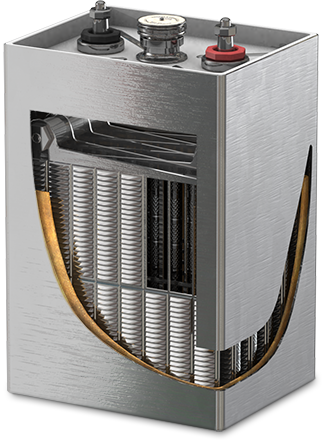
Thomas Edison’s vision of the future included the promise of a more efficient battery for electric vehicles, one that would revolutionize the way we use energy. His nickel-iron battery was designed for a 100-mile range and quick charging, a significant improvement over the lead-acid batteries of the time. However, while his battery showed promise, it never achieved mass adoption. Fast forward to today, and an international team of scientists, led by UCLA researchers, has reimagined Edison’s design with cutting-edge nanotechnology, creating a battery ideal for storing solar farm energy. This breakthrough could change how we store and utilize renewable energy.
Reinventing Edison’s Nickel-Iron Battery
The new research, led by UCLA’s Maher El-Kady and Ric Kaner, has breathed new life into Edison’s concept, overcoming past limitations. The researchers created a prototype of the nickel-iron battery that can now recharge in seconds instead of hours. Additionally, the battery’s endurance has improved drastically, with the prototype capable of withstanding more than 12,000 cycles—equivalent to 30 years of daily use. This is a significant advancement from the original design, which struggled to meet practical needs due to its slow recharge time and short lifespan.
A Simple Yet Revolutionary Approach
Despite the advanced technology, the researchers emphasize that their approach is surprisingly simple. They used proteins, byproducts of beef production, as scaffolds to form tiny clusters of metal like nickel and iron. These clusters were then bonded to a two-dimensional material only one atom thick. This method is inexpensive, efficient, and surprisingly effective, demonstrating that groundbreaking advancements don’t always require complex, expensive processes.
Nature-Inspired Technology
The team’s approach draws inspiration from natural processes, particularly how animals form bones and how shellfish create their hard outer shells. In nature, proteins guide the deposition of minerals to form strong yet flexible structures. By mimicking this process, the researchers were able to create metal clusters that are not only tiny but also highly efficient in storing and releasing energy. This technique allows the battery to charge and discharge much faster than previous versions.
How Surface Area Improves Battery Efficiency
One of the key factors behind the battery’s improved performance is its surface area. The graphene aerogel used in the battery has a massive surface area, which allows for more reactions to take place. This makes the battery more efficient, allowing it to store more energy and charge faster. As the metal clusters become smaller, the surface area increases exponentially, making almost every atom available for the battery’s chemical reactions.
A Step Toward Sustainable Energy Storage
Although this new battery technology does not yet match the energy storage capacity of lithium-ion batteries, it holds great promise for specific applications. Its quick charging and durability make it an excellent candidate for storing excess energy generated by solar farms during the day, to be used at night. This could provide a solution to the intermittent nature of solar power, ensuring a steady supply of renewable energy without worrying about infrastructure costs.
Looking Ahead
The team is already exploring ways to improve this technology further, such as experimenting with other metals and natural polymers to replace the bovine proteins. The future of this technology looks promising, with potential applications in renewable energy storage, backup power systems for data centers, and even in energy grids for a more sustainable future.
By taking inspiration from Thomas Edison’s early work, modern scientists have made a breakthrough that could redefine how we think about energy storage. This new battery design offers a faster, more durable, and efficient solution to storing energy, especially from renewable sources like solar power. As the technology develops, it has the potential to become a key player in the global transition to clean, sustainable energy.